
• Skip to main content
  • Skip to navigation
  • Accessibility
  • Contact Us
Government of Western Australia Crest
Government of Western Australia
Government of Western Australia Crest

Additional Menu

  • Accessibility
  • Contact us
Go to WA Government search
  • About us
    • Overview
    • Vision and values
    • Our structure
      • Board
      • Executive
      • District Health Advisory Councils
    • Our research
      • Clinical trials
      • Innovation
      • Research
    • Building projects
      • Project - Bunbury Regional Hospital redevelopment
      • Project – Laverton Hospital
      • Project – Tom Price and Paraburdoo Hospitals
      • Project - Geraldton Health Campus
      • Project - Mullewa Community Hospital
      • Completed projects
      • Country health housing
    • Publications
      • Annual reports
      • Strategic plans
      • Health profiles and service plans
      • Policies
      • Resources
    • Contact us
      • Provide feedback
      • Aishwarya’s CARE Call
  • Our services
    • Kimberley
      • Kimberley regional profile
      • Kimberley local health directory
      • Kimberley health services
      • Kimberley contacts
    • Pilbara
      • Pilbara regional profile
      • Pilbara local health directory
      • Pilbara health services
      • Pilbara contacts
    • Midwest
      • Midwest regional profile
      • Midwest local health directory
      • Midwest health services
      • Midwest contacts
    • Goldfields
      • Goldfields regional profile
      • Goldfields local health directory
      • Goldfields health services
      • Goldfields contacts
    • Wheatbelt
      • Wheatbelt regional profile
      • Wheatbelt health services
      • Wheatbelt contacts
    • South West
      • South West regional profile
      • South West local health directory
      • South West health services
      • South West contacts
    • Great Southern
      • Great Southern regional profile
      • Great Southern local health directory
      • Great Southern health services
      • Great Southern contacts
    • Home Hospital
    • Command Centre
      • Acute Patient Transfer Coordination
      • Acute Specialist Telehealth Service
      • Advanced Patient Monitoring System
      • Emergency Telehealth Service
      • Inpatient Telehealth Service
      • Mental Health Emergency Telehealth Service
    • Voluntary assisted dying
  • Our patients
    • Patient Assisted Travel Scheme - PATS
      • About PATS
      • PATS contacts
      • PATS claim forms and information sheets
      • PATS processes explained
      • PATS subsidies
      • PATS eligibility
      • Eligible specialist medical services
      • Frequently asked questions
    • Country PatHS
    • Live Organ Donor Travel and Accommodation Reimbursement Scheme
    • Telehealth
      • Is telehealth suitable for me?
      • Do you already have a telehealth appointment scheduled?
      • Telehealth for non-government organisations and health professionals
      • Telehealth stories
      • Emergency Telehealth Service
      • Telehealth technical support and regional contacts
    • Information for kids and teens
  • Our workforce
    • Work with us
      • Living and working in country WA
      • Medical workforce and education
      • Nursing and midwifery careers
      • Allied health and health science careers
      • Online Contractor Registration and Induction
    • Students
      • Career prospects
      • Work experience
      • University and TAFE study
      • Financial assistance
      • Student health professionals
    • Scholarships and grants
  • News
  1. Home
  2. News
  3. 2026
  4. 06
  5. 09
  6. $1 million boost to accelerate elimination of rheumatic heart disease in Western Australia

$1 million boost to accelerate elimination of rheumatic heart disease in Western Australia
$1 million boost to accelerate elimination of rheumatic heart disease in Western Australia

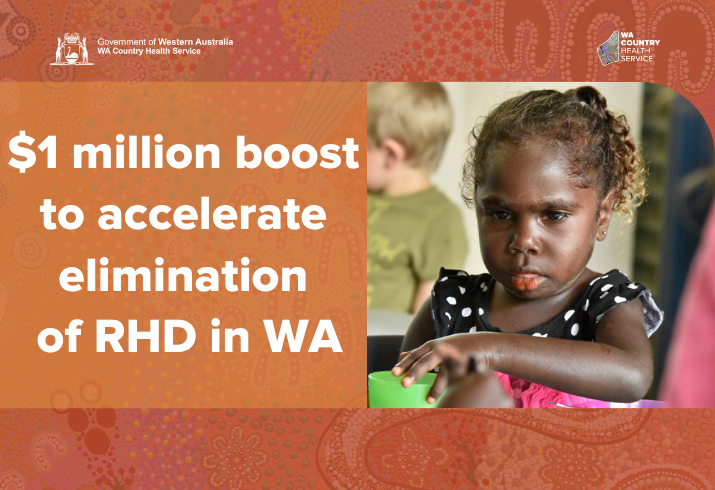
Girl playing a game with a clinician
09/06/2026

Efforts to eliminate rheumatic heart disease (RHD) have been significantly strengthened, with a $1 million grant awarded through the Future Health Research and Innovation Fund (FHRI) Spotlight Program.


The Aboriginal Health Council of Western Australia (AHCWA), WA Country Health Service (WACHS) and The Kids Research Institute Australia (The Kids), through its affiliation with The University of Western Australia, will work together to develop a coordinated, Statewide action plan to address RHD. The partnership will be known as END RHD WA.


Acute rheumatic fever (ARF) and RHD remain major drivers of preventable illness and premature death, particularly among Aboriginal and Torres Strait Islander people. While preventable and manageable, these conditions require sustained, culturally safe and coordinated care.


Without appropriate treatment, RHD can lead to heart failure and the need for complex heart surgery, alongside lifelong medical care.


The State Government’s FHRI Fund Strategy 2025-30 commits to one major, uniquely Western Australian issue each year, providing multi-year funding support of up to $25 million in each round.


The initial funding to the Spotlight Coordinating Team will support the establishment of strong partnerships, meaningful community consultation and engagement with key stakeholders to design a transformative research and service delivery program. The team will present its planned approach to government for review, before a further $24 million investment is considered.


A key feature of the partnership approach is strong Aboriginal leadership and involvement, right from the start.


Chair of the Aboriginal Health Council of Western Australia, Vicki O’Donnell OAM, said the partnership recognised that Aboriginal communities must be the architects of their own health futures.


“Our Member Services bring decades of cultural knowledge and clinical experience. When that knowledge leads the way, we build programs that are culturally strong, trusted and effective,” Ms O’Donnell said.


“For too long, decisions about Aboriginal health have been made far away from the communities most affected. This Spotlight initiative is an opportunity to reset that approach and put community control at the centre.”


WA Country Health Service Chief Executive Jeff Moffet said the collaboration would strengthen and improve care and service coordination across regional and remote communities.


“WA Country Health Service is proud to partner with ACHWA and The Kids Research Institute Australia on this important, Aboriginal and community-led initiative to eradicate RHD in Western Australia,” Mr Moffet said.


“Working together through this program we will implement evidence-based practices supported by research to address the health challenges faced.”


Professor Jonathan Carapetis, Executive Director at The Kids and an internationally recognised leader in Strep A and RHD research, said the initiative would prioritise collaboration, cultural safety and the inclusion of lived experience at all stages of research and implementation, with the aim of reducing the burden of ARF and RHD and improving quality of life across Western Australia.


“We are committed to working in genuine partnership to ensure solutions are evidence-based, culturally safe and deliver real improvements in prevention, diagnosis and care,” Professor Carapetis said.


“This investment brings together research, clinical care and community leadership to tackle RHD in a coordinated and meaningful way.”


The Kids is already leading a strong pipeline of work to reduce the burden of RHD and ARF, spanning prevention, treatment and community action. This includes advancing the development of a Strep A vaccine, improving treatment and management protocols for people living with RHD, and working with communities to reduce skin infections that drive Strep A transmission.

Last Updated: 09/06/2026
  • Facebook
  • LinkedIn
  • YouTube

Footer menu

  • wa.gov.au
  • Copyright
  • Disclaimer
  • Privacy
  • Sitemap
  • Contact Us

Brought to you by the Department of Health, Western Australia

© Government of Western Australia 2018 to