
• Skip to main content
  • Skip to navigation
  • Accessibility
  • Contact Us
Government of Western Australia Crest
Government of Western Australia
Government of Western Australia Crest

Additional Menu

  • Accessibility
  • Contact us
Go to WA Government search
  • About us
    • Overview
    • Vision and values
    • Our structure
      • Board
      • Executive
      • District Health Advisory Councils
    • Our research
      • Clinical trials
      • Innovation
      • Research
    • Building projects
      • Project - Bunbury Regional Hospital redevelopment
      • Project – Laverton Hospital
      • Project – Tom Price and Paraburdoo Hospitals
      • Project - Geraldton Health Campus
      • Project - Mullewa Community Hospital
      • Completed projects
      • Country health housing
    • Publications
      • Annual reports
      • Strategic plans
      • Health profiles and service plans
      • Policies
      • Resources
    • Privacy and information sharing
    • Contact us
      • Provide feedback
      • Aishwarya’s CARE Call
  • Our services
    • Kimberley
      • Kimberley regional profile
      • Kimberley local health directory
      • Kimberley health services
      • Kimberley contacts
    • Pilbara
      • Pilbara regional profile
      • Pilbara local health directory
      • Pilbara health services
      • Pilbara contacts
    • Midwest
      • Midwest regional profile
      • Midwest local health directory
      • Midwest health services
      • Midwest contacts
    • Goldfields
      • Goldfields regional profile
      • Goldfields local health directory
      • Goldfields health services
      • Goldfields contacts
    • Wheatbelt
      • Wheatbelt regional profile
      • Wheatbelt health services
      • Wheatbelt contacts
    • South West
      • South West regional profile
      • South West local health directory
      • South West health services
      • South West contacts
    • Great Southern
      • Great Southern regional profile
      • Great Southern local health directory
      • Great Southern health services
      • Great Southern contacts
    • Home Hospital
    • Command Centre
      • Acute Patient Transfer Coordination
      • Acute Specialist Telehealth Service
      • Advanced Patient Monitoring System
      • Emergency Telehealth Service
      • Inpatient Telehealth Service
      • Mental Health Emergency Telehealth Service
    • Voluntary assisted dying
  • Our patients
    • Patient Assisted Travel Scheme - PATS
      • How to apply
      • PATS subsidies
      • PATS eligibility
      • PATS contacts
    • Country PatHS
    • Live Organ Donor Travel and Accommodation Reimbursement Scheme
    • Telehealth
      • Is telehealth suitable for me?
      • Do you already have a telehealth appointment scheduled?
      • Telehealth for non-government organisations and health professionals
      • Telehealth stories
      • Emergency Telehealth Service
      • Telehealth technical support and regional contacts
    • Information for kids and teens
    • Disability access and inclusion
  • Our workforce
    • Work with us
      • Living and working in country WA
      • Medical workforce and education
      • Nursing and midwifery careers
      • Allied health and health science careers
      • Online Contractor Registration and Induction
      • Country Nursing and Midwifery Incentive Program 2.0
    • Students
      • Career prospects
      • Work experience
      • University and TAFE study
      • Financial assistance
      • Student health professionals
    • Scholarships and grants
  • News
  1. Home
  2. News
  3. 2026
  4. 08
  5. 04
  6. F.A.S.T thinking saved Bunbury resident

F.A.S.T thinking saved Bunbury resident
F.A.S.T thinking saved Bunbury resident

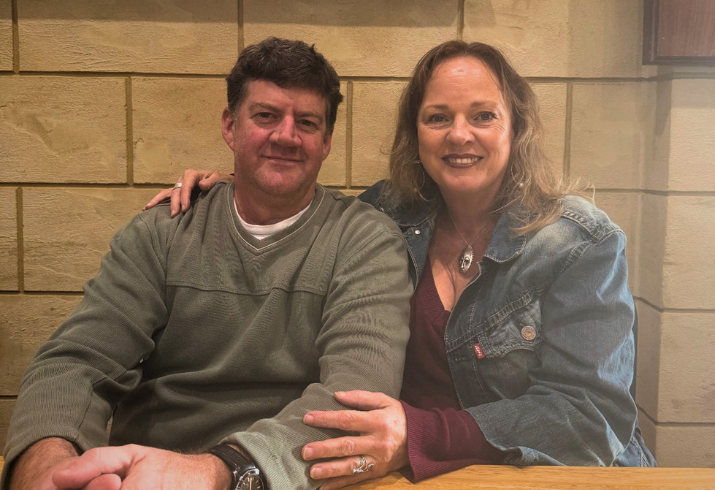
Man and woman sitting at table.
04/08/2026

When Bunbury resident Kerry suddenly collapsed, her husband immediately rushed to her aid. Realising the seriousness of her symptoms, he called triple zero and the Bunbury Regional Hospital took it from there.

This National Stroke Week (3 - 9 August), Kerry shares her story to remind others that knowing the signs of a stroke and acting quickly can save a life.

It was a typical day for Kerry until she collapsed while in the shower. With no warning signs and no experience of these symptoms prior, a stroke was the last thing she thought she was having.

“I got in the shower and the next thing I knew I was on the ground - I had no idea what was going on,” she said.

Her husband heard her collapse, rushed in to see what had happened, and realised something wasn’t right.

Once he sat her down, she couldn’t move her body, her words then became slurred - that’s when he immediately rang triple zero.

Kerry was then rushed to Bunbury Regional Hospital by ambulance.

Once arrived, clinicians at the local hospital assessed her and linked in with the 24/7 Telestroke service to consult with a specialist stroke neurologist. Tests confirmed she had suffered a stroke.

Following the assessment, it was recommended that Kerry be transferred to Perth for surgery and returned home five days later. 

South West Stroke Coordinator Renee Dehring said strokes are very serious and should be treated immediately.

“Everyone worked together quickly to get Kerry the care she needed,” she said.

“Strokes are a serious medical emergency, so it is incredibly important that everyone knows the signs and understands what to do when a stroke occurs.”

Thanks to her husband's quick actions, Kerry was able to receive time-critical stroke treatment sooner, helping her make a faster recovery.

Kerry acknowledges all the staff who cared for her and encourages others to learn the signs of stroke.

“I can’t thank them enough for what they did,” she added.

“It’s very important to know the signs - it could save a life.

“Who knows where I would be now if I had left it longer without getting help.”

For Kerry, she also continued rehabilitation through outpatient stroke occupational therapy at Bunbury Regional Hospital, which has helped regain her confidence and independence again.

Now recovering, Kerry is looking forward to spending more time with her husband of 22 years and their three children.

The Stroke Foundation recommends the F.A.S.T test as an easy way to remember the most common signs of a stroke. Using the F.A.S.T test involves asking these simple questions.

  • Face – Check their face. Has their mouth drooped?
  • Arms – Can they lift both arms?
  • Speech – Is their speech slurred? Do they understand you?
  • Time – Is critical. If you see any of these signs, call 000 straight away.

A stroke is always a medical emergency.

Last Updated: 04/08/2026
  • Facebook
  • LinkedIn
  • YouTube

Footer menu

  • wa.gov.au
  • Copyright
  • Disclaimer
  • Privacy
  • Sitemap
  • Contact Us

Brought to you by the Department of Health, Western Australia

© Government of Western Australia 2018 to