
• Skip to main content
  • Skip to navigation
  • Accessibility
  • Contact Us
Government of Western Australia Crest
Government of Western Australia
Government of Western Australia Crest

Additional Menu

  • Accessibility
  • Contact us
Go to WA Government search
  • About us
    • Overview
    • Vision and values
    • Our structure
      • Board
      • Executive
      • District Health Advisory Councils
    • Our research
      • Clinical trials
      • Innovation
      • Research
    • Building projects
      • Project - Bunbury Regional Hospital redevelopment
      • Project – Laverton Hospital
      • Project – Tom Price and Paraburdoo Hospitals
      • Project - Geraldton Health Campus
      • Project - Mullewa Community Hospital
      • Completed projects
      • Country health housing
    • Publications
      • Annual reports
      • Strategic plans
      • Health profiles and service plans
      • Policies
    • Contact us
      • Provide feedback
      • Aishwarya’s CARE Call
  • Our services
    • Kimberley
      • Kimberley regional profile
      • Kimberley local health directory
      • Kimberley health services
      • Kimberley contacts
    • Pilbara
      • Pilbara regional profile
      • Pilbara local health directory
      • Pilbara health services
      • Pilbara contacts
    • Midwest
      • Midwest regional profile
      • Midwest local health directory
      • Midwest health services
      • Midwest contacts
    • Goldfields
      • Goldfields regional profile
      • Goldfields local health directory
      • Goldfields health services
      • Goldfields contacts
    • Wheatbelt
      • Wheatbelt regional profile
      • Wheatbelt health services
      • Wheatbelt contacts
    • South West
      • South West regional profile
      • South West local health directory
      • South West health services
      • South West contacts
    • Great Southern
      • Great Southern regional profile
      • Great Southern local health directory
      • Great Southern health services
      • Great Southern contacts
    • Home Hospital
    • Command Centre
      • Acute Patient Transfer Coordination
      • Acute Specialist Telehealth Service
      • Advanced Patient Monitoring System
      • Emergency Telehealth Service
      • Inpatient Telehealth Service
      • Mental Health Emergency Telehealth Service
    • Voluntary assisted dying
  • Our patients
    • Patient Assisted Travel Scheme - PATS
      • About PATS
      • PATS contacts
      • PATS claim forms and information sheets
      • PATS processes explained
      • PATS subsidies
      • PATS eligibility
      • Eligible specialist medical services
      • Frequently asked questions
    • Country PatHS
    • Live Organ Donor Travel and Accommodation Reimbursement Scheme
    • Telehealth
      • Is telehealth suitable for me?
      • Do you already have a telehealth appointment scheduled?
      • Telehealth for non-government organisations and health professionals
      • Telehealth stories
      • Emergency Telehealth Service
      • Telehealth technical support and regional contacts
    • Information for kids and teens
  • Our workforce
    • Work with us
      • Living and working in country WA
      • Medical workforce and education
      • Nursing and midwifery careers
      • Allied health and health science careers
      • Online Contractor Registration and Induction
    • Students
      • Career prospects
      • Work experience
      • University and TAFE study
      • Financial assistance
      • Student health professionals
    • Scholarships and grants
  • News
  1. Home
  2. News
  3. 2025
  4. 12
  5. 20
  6. HEALTH ALERT: Protect yourself against extreme heat

HEALTH ALERT: Protect yourself against extreme heat
HEALTH ALERT: Protect yourself against extreme heat

20/12/2025

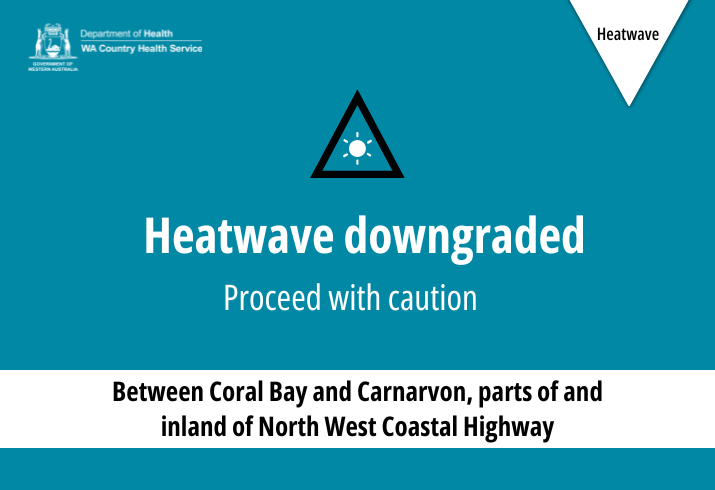
Update as at Monday 22 December 2025, 14:48pm: Heatwave Advice - THREAT IS REDUCED - Between Coral Bay and Minilya Roadhouse, as well as parts of North West Coastal Highway and inland of North West Coastal Highway from Carnarvon and north to Lyndon River.

Heatwave conditions have passed.

Coping with hot weather can be stressful and tiring. It can take a couple of days for you to recover completely.

To help you stay healthy after hot weather or extreme heat:

  • Continue to drink plenty of water so your body can get back in balance.
  • Open windows and doors during cooler parts of the day to ventilate and cool your home if it is safe to do so.
  • Get plenty of rest.
  • If you feel unwell, make a time to see your healthcare practitioner.
  • Contact family and friends to see how they coped and to check if they need help.
  • Think about the things you could do differently, so you are more prepared to cope next time it is very hot.
  • Make any changes needed to your home so it will be more comfortable next time there is hot weather or extreme heat.


Update as at Sunday 21 December, 14:30pm: WATCH AND ACT – PROTECT YOURSELF AGAINST THE IMPACTS OF EXTREME HEAT.

Impacted area now includes parts of North West Coastal Highway, as well as inland of North West Coastal Highway from Carnarvon and north to Lyndon River, and areas between Coral Bay and Minilya Roadhouse.

People travelling in this area should be prepared for extreme heat.


Current as at: 19:30pm, Saturday 20 December 2025. Heatwave WATCH AND ACT – PROTECT YOURSELF AGAINST THE IMPACTS OF EXTREME HEAT.

WA Country Health Service is advising people travelling between Coral Bay and Minilya Roadhouse, as well as inland of North West Coastal Highway from Carnarvon and north to the Lyndon River to prepare for extreme heat.

A heatwave is currently impacting this area and is expected to last until Tuesday 23 December.

Health safety advice:

  • Avoid travelling in the hottest part of the day where possible.
  • Keep hydrated by drinking plenty of fluids. Fluids include water, diluted juice (mixed with water) and low sugar sports drinks.
  • Limit or avoid alcohol and caffeinated drinks (including tea, coffee and energy drinks) as these can increase dehydration.
  • Never leave a person or a pet in a vehicle.
  • Avoid exercise and outdoor work in the hottest part of the day.
  • If you must go out, wear a hat and sunscreen and take sufficient water with you.
  • When outdoors, wear lightweight, light-coloured and loose-fitting clothing that covers as much skin as possible.
  • Seek a place to keep cool, such as your home, a library, community centre or shopping centre.
  • Close your windows and draw blinds, curtains or awnings early in the day to keep the heat out of your home.
  • If available, use fans or air-conditioners to keep cool.
  • Check in regularly with elderly neighbours and other vulnerable people.
  • Provide shelter and plenty of cool water for pets and other animals.
  • Sleep with just a sheet over you in the coolest part of the house. Remove winter bedding and replace it with lightweight, cotton bedding.
  • Wrap medications needing refrigeration in foil or heat repellent containers with an icepack to keep them cool if there is a power outage.
  • Charge mobile devices in the event there is a power outage.
  • Get a battery powered radio with working batteries.

For information on staying safe during a heatwave visit HealthyWA - Heatwaves and Working Safely in Hot Conditions.


Last Updated: 23/12/2025
  • Facebook
  • LinkedIn
  • YouTube

Footer menu

  • wa.gov.au
  • Copyright
  • Disclaimer
  • Privacy
  • Sitemap
  • Contact Us

Brought to you by the Department of Health, Western Australia

© Government of Western Australia 2018 to